


-
About the Ministry
About the Ministry
- Press
- Countries & Regions
- Policy Information
-
About Korea
About Korea


Ministry News
- Notices
- Ministry News
- Press Releases
- Press Briefings
- Speeches & Published Materials
- Newsletter Service
- Diplomatic White Paper


Seeking Ways to Use AI for Inclusive and Sustainable Development Cooperation
- Date
- 2026-09-28
- hit
- 77
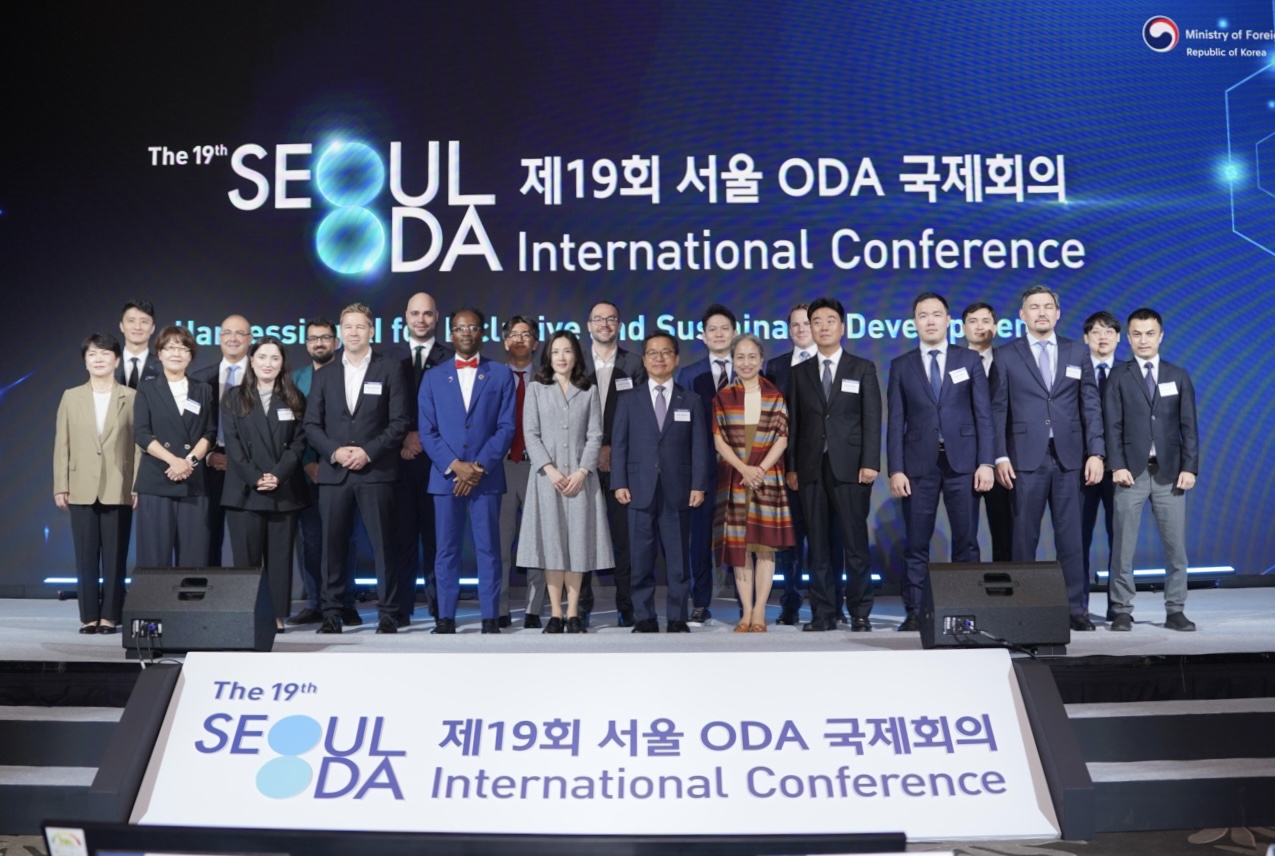
- MOFA and KOICA co-hosted the 19th Seoul ODA International Conference in conjunction with the first Korea–Central Asia Summit -
[Related National Policy Task] No. 120: Emerging as a G7+ Diplomatic Power through Contributions and Active Engagement in the International Community
The Ministry of Foreign Affairs (MOFA) and the Korea International Cooperation Agency (KOICA) jointly hosted the 19th Seoul ODA (Official Development Assistance)* International Conference at the Conrad Seoul Hotel in Yeouido on September 18 (Friday). The Seoul ODA International Conference is Korea's largest annual conference on ODA. This year's conference, themed "Artificial Intelligence (AI) for Inclusive and Sustainable Development," brought together representatives from the development cooperation community including governments, international organizations, academia and industry at home and abroad.
* Official Development Assistance (ODA) is aid provided by government and other public institutions for developing countries to help them promote economic development and social welfare.
Participants agreed that fully realizing diverse opportunities AI brings to development cooperation requires careful consideration of each country's differing digital infrastructure as well as its human and institutional conditions. Their discussions focused on how to tailor the use of AI to the circumstances and needs of partner countries and ensure that technology gaps do not cause wider inequality.
In her welcoming remarks, Vice Minister of Foreign Affairs Kim Jina said that while AI is creating new opportunities for productivity, innovation and development, existing gaps could widen further if its benefits are not shared broadly. She stressed that the task of development cooperation is not simply to expand access to technology but to help each partner country build the capacity and sense of ownership needed to use and advance AI in line with its own circumstances. She added that Korea would continue to work as a responsible partner so that “no one is left behind in the age of AI."
In his opening remarks, KOICA Acting President Kim Dong-ho said the conference would serve as an opportunity to move beyond conceptual discussions of development cooperation in the AI era and for businesses, civil society and partner-country governments to jointly explore concrete courses of action.
In his keynote address, Dr. Landry Signé, Senior Fellow at the Brookings Institution, argued that developing countries should become co-creators of the AI transition rather than mere consumers of technology, and called for an inclusive AI governance and new partnerships to make this possible.
The first session on "Designing Development Cooperation in the AI Era" examined the foundations and principles needed to advance AI-related development cooperation. Director-General for Development Cooperation at MOFA Lee Kyooho introduced the Korean government's strategy for grant assistance related AI and science and technology, while head at the International Telecommunication Union (ITU) Hani Eskandar and KAIST Professor Park Kyung Ryul, who studies sustainable development and global technology governance, shared perspectives on building AI infrastructure and on inclusive AI governance, respectively.
Participants noted that, in the AI era, it is important to expand not only internet connectivity but also cloud computing, data and digital public infrastructure, alongside talent development. They also stressed the need to design AI with attention to partner countries' own languages, data and institutions, and to ensure that partner countries take part from the design stage onward as capable participants rather than remaining mere beneficiaries.
The second session on "AI Development Cooperation in the Field" showcased real-world examples of AI applications in development cooperation. 60Hertz, a company participating in KOICA's corporate partnership program, presented its use of IT solutions and virtual power plant (VPP) technology to expand the distribution of renewable energy in Vietnam. Wadhwani AI introduced its mobile AI applications in India's healthcare sector, and Norway's development cooperation agency, Norad, shared its experience of using AI to automate aid administration and support data-driven decision-making.
The third session was organized as a special session to deepen AI-related ODA cooperation with five Central Asian countries, building on the outcomes of the first Korea–Central Asia Summit held on September 16. Under the theme "A Strategic Partnership for Korea–Central Asia AI ODA," officials from KOICA, the World Bank, the Asian Development Bank (ADB) and the government of Tajikistan shared the progress in AI and digital cooperation under way in Central Asia, while government representatives from Uzbekistan, Kyrgyzstan, Tajikistan, Kazakhstan and Turkmenistan exchanged views on future cooperation in a panel discussion.
Participants emphasized that, given the differing levels of digital development, infrastructure and human resources across Central Asian countries, cooperation should reflect each country's own strategy and needs rather than pursue uniform technology transfer. They also identified AI talent development, expanded computing infrastructure, and the development of technologies based on local languages as key areas for future cooperation. MOFA and KOICA plan to actively incorporate the outcome of the discussions held at this conference into their future Korea–Central Asia AI ODA initiatives.
As a side event, a "KOICA AI Partners Fair" was held, featuring ten Korean AI companies* that presented AI and digital technologies spanning education, healthcare, energy, agriculture and other fields. The fair gave Korean companies an opportunity to explore entry into the development cooperation market and to network with overseas partners.
* DataMaker, TagHive, weplat, AIWorks, Visang Education, 60Hertz, LiveCare, Medisapiens, Pipetree, AIMD
Amid growing calls for international cooperation to narrow the AI gap between nations and to harness AI for the sustainable development of developing countries during this period of digital and AI transformation, MOFA designated AI as a priority ODA area and established its "Grant-based AI ODA Strategy" in July of this year. Building on the results of the discussions held at this conference, MOFA and KOICA plan to continue advancing inclusive and sustainable AI development cooperation together.