


-
About the Ministry
About the Ministry
- Press
- Countries & Regions
- Policy Information
-
About Korea
About Korea


Ministry News
- Notices
- Ministry News
- Press Releases
- Press Briefings
- Speeches & Published Materials
- Newsletter Service
- Diplomatic White Paper


Vice Minister Kim Jina Attends G7 Development Ministers’ Meeting
- Date
- 2026-05-01
- hit
- 1089
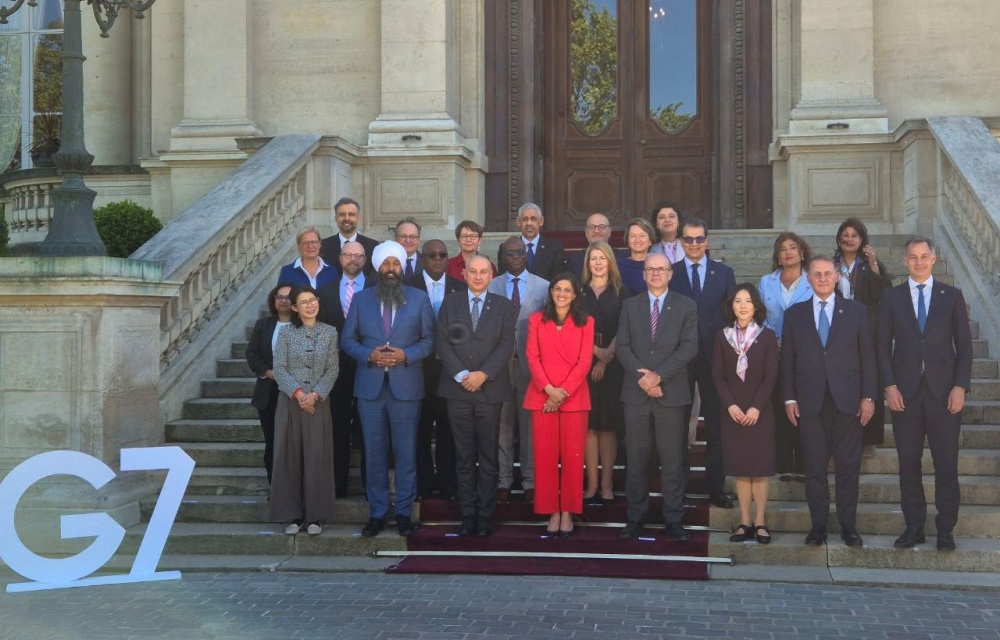
- Korea, invited to the G7 Development Ministers’ Meeting for the first time, played an active role in shaping agendas and norms in international development cooperation -
- Korea emphasized the need to reform the development cooperation architecture and reduce fragmentation while maintaining the core role of ODA -
Vice Minister of Foreign Affairs Kim Jina attended the G7 Development Ministers’ Meeting held in Paris, France, from Wednesday, April 29, to Thursday, April 30, at the invitation of France, which holds the G7 Presidency this year. During the meeting, participants discussed key issues in international development cooperation, including △reforming the development cooperation architecture and diversifying financing for development and △reducing fragmentation and improving mechanisms for coordination. In addition to G7 member states, partner countries such as the Republic of Korea, Brazil, India, Kenya, Côte d’Ivoire, and Morocco also participated in the meeting.
On this occasion, participating countries discussed “international partnerships,” one of the main pillars of the G7 Evian Summit (June 15–17). The outcomes of these discussions are expected to be carried forward to the upcoming Evian Summit.
As a first-time invitee to the G7 Development Ministers’ Meeting and its working-level sessions, Korea engaged in in-depth discussions with G7 members on the future direction of international development cooperation amid a rapidly changing global order and global poly-crises.
In the expanded session, Vice Minister Kim noted that international development cooperation is undergoing a structural transformation, characterized by increased private financing and the participation of a wider range of development actors. She pointed out that, amid these changes, the complexity and fragmentation of the development cooperation system are intensifying, and stressed that without effective coordination among diverse partners, the effectiveness of development cooperation could continue to be undermined.
In this regard, Vice Minister Kim emphasized the need to move beyond donor-centric coordination toward a “harmonization among partners” approach that encompasses a broad range of development actors. She underscored that each actor should strengthen cooperation based on a clear division of roles and comparative advantages. She also highlighted that reinforcing partner countries’ ownership would enable more sustainable development cooperation, reiterating the importance of enhancing development effectiveness. Major partners, including the OECD, expressed support for her remarks.
On the sidelines of the meeting, Vice Minister Kim held bilateral meetings with France’s Minister Delegate for Francophonie, International Partnerships and French Nationals Abroad, Eleonore Caroit; Germany’s Federal Minister for Economic Cooperation and Development, Reem Alabali Radovan; and Japan’s State Minister for Foreign Affairs, Ayano Kunimitsu, where they discussed key issues and ways to strengthen bilateral cooperation.
Participation in this meeting is seen as a meaningful opportunity to strengthen cooperation with G7 members—which provide approximately 70% of global ODA—as well as major Global South partners such as India and Brazil, at a time when discussions on reforming the development cooperation architecture and mobilizing innovative financing are intensifying. It also served to enhance Korea’s role and standing as a responsible global power. The Korean government will continue to actively engage in discussions on improving the effectiveness of international development cooperation and shaping global norms for sustainable development.